

In the fast-moving world of crypto trading, consistently profitable strategies remain a top priority for both new and experienced traders. As we move through 2025, the bid-ask strategy stands out as a time-tested approach to capitalize on market microstructure, especially as liquidity deepens in major assets like Bitcoin and Ethereum. With Bitcoin currently priced at $95,034.00 and Ethereum at $3,170.14, understanding how to leverage the bid-ask spread is more relevant than ever for those aiming to maximize returns while minimizing risk.
Dissecting the Bid-Ask Spread: What Every Crypto Trader Must Know
The foundation of the bid-ask strategy lies in grasping the mechanics of the spread itself. The bid price is the highest amount a buyer is willing to pay for an asset, while the ask price is the lowest price a seller will accept. The difference between these two figures - known as the spread - represents both a transaction cost and an opportunity for profit.
This spread fluctuates based on several factors:
- Liquidity: Highly traded cryptocurrencies like Bitcoin and Ethereum usually have tighter (smaller) spreads due to intense buying and selling activity.
- Volatility: In periods of rapid price movement, spreads often widen as market makers adjust quotes to manage risk.
- Order Book Depth: A deeper order book with more buy/sell interest at multiple levels helps keep spreads narrow.
If you’re trading in markets with wide spreads or thin liquidity, even small trades can be costly. That’s why professional traders carefully select assets and timing when deploying any bid-ask strategy.
Tactical Steps: Applying the Bid-Ask Strategy in 2025's Crypto Market
The goal of a bid-ask strategy is straightforward: buy at or near the bid price and sell at or near the ask price, repeatedly capturing small profits that add up over time. Here’s how traders are putting this into practice right now:
- Select High-Liquidity Pairs: Focus on assets with high daily volumes (like BTC/USDT or ETH/USDT), where spreads are routinely tight - often just a few dollars apart even when Bitcoin trades above $95,000.
- Avoid Market Orders During Volatility: Market orders execute immediately but may fill at unfavorable prices if spreads widen suddenly. Instead, use limit orders to specify your entry/exit point within your risk parameters.
- Monitor Order Book Dynamics: Use advanced trading platforms that display real-time order books so you can spot shifts in liquidity or sudden changes in spread width before placing trades.
- Pursue Small but Consistent Gains: Bid-ask strategies thrive on frequency rather than magnitude; dozens of micro-profits can compound significantly over weeks or months if executed with discipline.
The current environment - with Bitcoin oscillating between $94,208.00 and $100,403.00 today alone - offers ample opportunities for nimble traders who know how to exploit these micro-movements without overexposing themselves to directional risk.
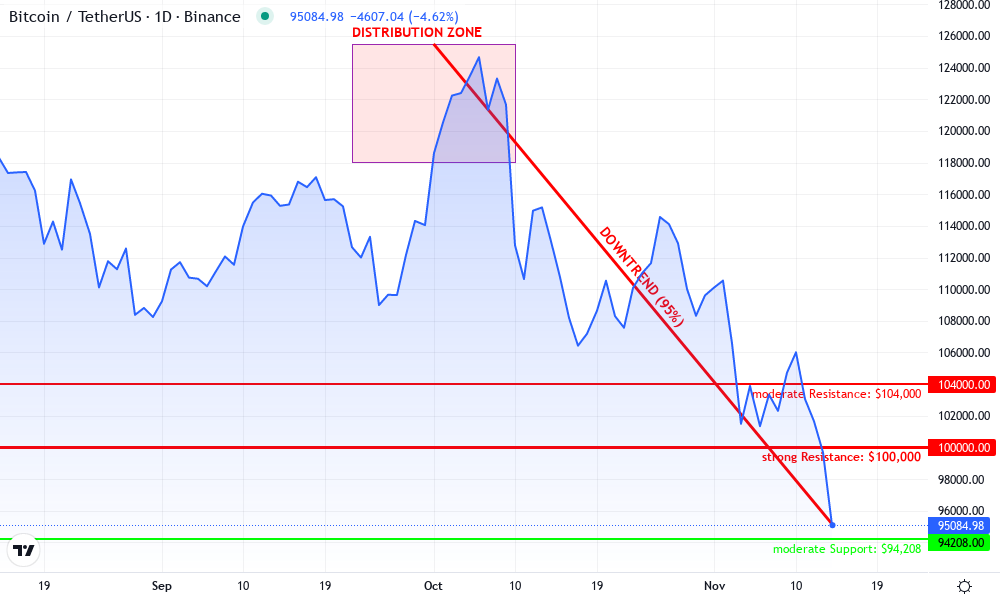
Bitcoin Technical Analysis Chart
Analysis by Renee Forsythe | Symbol: BINANCE:BTCUSDT | Interval: 1D | Drawings: 5
Technical Analysis Summary
Start by marking the primary downtrend line from the October peak (~$125,500) to the current price at $95,169 (November 14, 2025). Draw horizontal support at $94,200 (recent intraday low) and $100,000 (psychological round number and recent support turn resistance). Highlight the distribution phase from late September to early October, then mark the breakdown post-October with a rectangle or price range. Add callouts for the sharp breakdown in November. Use arrow markers to indicate the sharp selloff days. Consider a text note on the importance of bid-ask spreads in this volatile region, especially as slippage risk increases near support breaks.
Risk Assessment: medium
Analysis: The market is in a clear downtrend with high volatility and significant psychological levels being tested. Short-term oversold conditions may present bounce opportunities, but risk of further downside remains if support fails.
Renee Forsythe's Recommendation: Wait for stabilization or evidence of reversal at or above $94,200 before considering new long positions. Use disciplined stops and avoid aggressive entries during heightened volatility.
Key Support & Resistance Levels
📈 Support Levels:
- $94,208 - Intraday low and immediate support; possible bounce zone. moderate
📉 Resistance Levels:
- $100,000 - Strong psychological and technical resistance, recent breakdown point. strong
- $104,000 - Minor resistance from early November consolidation. moderate
Trading Zones (medium risk tolerance)
🎯 Entry Zones:
- $95,000 - Potential oversold bounce or scalp if price stabilizes and reversal signal appears. Medium risk—wait for confirmation. medium risk
🚪 Exit Zones:
- $100,000 - Profit target at former support/now resistance. 💰 profit target
- $94,000 - Stop-loss below recent lows to contain downside if breakdown accelerates. 🛡️ stop loss
Technical Indicators Analysis
📊 Volume Analysis:
Pattern: Not visible on chart, but expect a spike on breakdown days. Add callout to volume area if available.
Spikes in volume likely accompanied the recent breakdown. Confirm with actual volume bars if visible.
📈 MACD Analysis:
Signal: Bearish momentum likely dominant, MACD would be below signal line and trending down.
Momentum is strongly bearish; MACD likely confirms the downtrend.
Applied TradingView Drawing Utilities
This chart analysis utilizes the following professional drawing tools:
Disclaimer: This technical analysis by Renee Forsythe is for educational purposes only and should not be considered as financial advice. Trading involves risk, and you should always do your own research before making investment decisions. Past performance does not guarantee future results. The analysis reflects the author's personal methodology and risk tolerance (medium).
The Role of Discipline and Risk Management in Bid-Ask Trading
No strategy is complete without robust risk controls. Because bid-ask trading often targets slim margins per trade, losses from slippage or sudden volatility can quickly erode gains if not managed properly. Here are key principles for safeguarding your capital:
- Set Strict Stop-Losses: Define maximum acceptable losses per trade based on your account size; never let one trade wipe out days of accumulated profits.
- Diversify Across Assets and Timeframes: Don’t concentrate all trades on one pair or during one session - spreading exposure helps smooth out variance from unexpected market moves.
- Avoid Overtrading: Only enter positions when spreads are favorable and liquidity supports quick entry/exit; forcing trades during illiquid moments increases costs dramatically.
This disciplined approach becomes especially vital during volatile periods like today’s session where Bitcoin has dropped by $3,709 (-0.0376%) since yesterday’s close but remains above key psychological levels.
Bitcoin (BTC) Price Prediction Table: 2026-2031
Forecasted BTC Price Ranges Based on Order Book Dynamics, Market Trends, and Bid-Ask Strategy Insights (2025 Baseline: $95,034)
| Year | Minimum Price (Bearish Scenario) | Average Price (Baseline) | Maximum Price (Bullish Scenario) | % Change (Avg vs. Prev. Year) | Market Scenario Insights |
|---|---|---|---|---|---|
| 2026 | $80,000 | $105,000 | $135,000 | +10.5% | Potential post-halving volatility; regulatory clarity boosts institutional inflows |
| 2027 | $90,000 | $120,000 | $155,000 | +14.3% | Steady adoption; increased DeFi integration; global crypto payment growth |
| 2028 | $105,000 | $140,000 | $185,000 | +16.7% | Major tech upgrades (scalability/privacy); possible ETF expansions |
| 2029 | $120,000 | $160,000 | $220,000 | +14.3% | Mainstream acceptance; macroeconomic uncertainty drives digital gold narrative |
| 2030 | $135,000 | $185,000 | $260,000 | +15.6% | Wider institutional adoption; regulatory frameworks stabilize; new use cases emerge |
| 2031 | $150,000 | $210,000 | $300,000 | +13.5% | BTC entrenched as reserve asset; potential new cycle highs; increased competition from altcoins |
Price Prediction Summary
Bitcoin is expected to show steady growth from its 2025 baseline of $95,034, with average prices potentially reaching $210,000 by 2031. While short-term volatility and regulatory shifts may cause fluctuations, the overall trend remains upward, supported by increasing adoption, technological advancements, and maturing market infrastructure. Minimum and maximum ranges reflect both bearish risks (e.g., regulatory crackdowns, macro downturns) and bullish catalysts (e.g., institutional inflows, tech upgrades).
Key Factors Affecting Bitcoin Price
- Market liquidity and depth (narrower bid-ask spreads favor efficient trading)
- Regulatory clarity and global policy developments
- Institutional adoption and ETF/derivative market growth
- Macro-economic trends (inflation, global instability)
- Technological upgrades (scalability, privacy, security)
- Competition from other cryptocurrencies (e.g., Ethereum, new blockchains)
- Market sentiment and behavioral cycles (post-halving, FOMO, corrections)
Disclaimer: Cryptocurrency price predictions are speculative and based on current market analysis. Actual prices may vary significantly due to market volatility, regulatory changes, and other factors. Always do your own research before making investment decisions.
Seasoned traders understand that the real edge in bid-ask strategy crypto trading often comes from rigorous execution and a relentless focus on process over prediction. In 2025’s rapidly evolving landscape, where Bitcoin holds at $95,034.00 and Ethereum at $3,170.14, the difference between a disciplined approach and impulsive trading is stark, especially as algorithmic and automated crypto trading strategies become more prevalent.
Automation, Tools, and the Human Element
Many traders are now leveraging advanced bots and scripts to automate their bid-ask spread executions. These tools can scan for optimal spreads in real time, place limit orders precisely at the edges, and exit positions as soon as micro-profits are realized, all while maintaining strict adherence to pre-set risk parameters. However, even with automation, human oversight remains critical: markets can shift in seconds due to macro news or sudden liquidity changes.
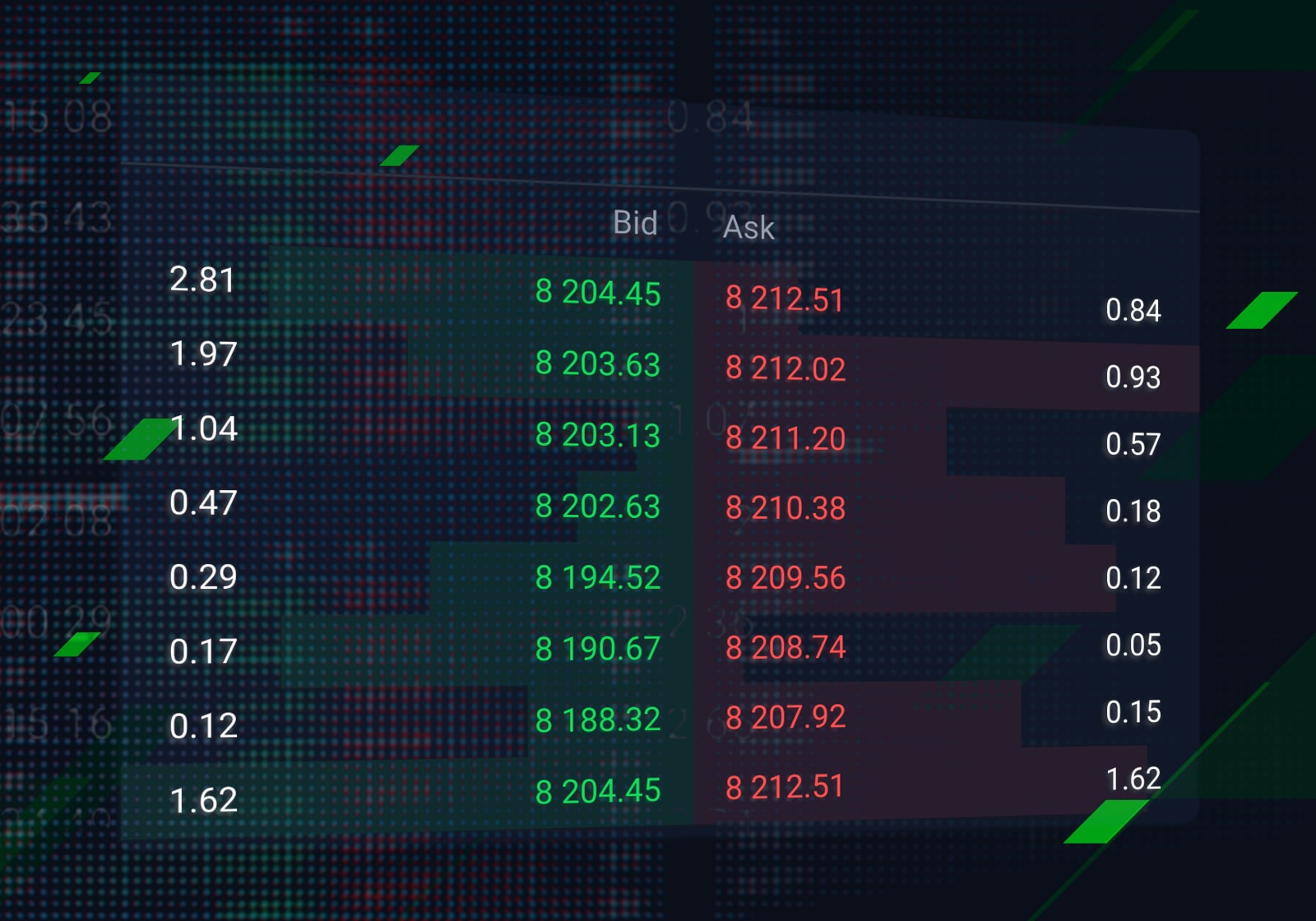
Key tip: Regularly review your bot’s performance logs to ensure it isn’t overtrading during periods of high slippage or illiquidity. Automated crypto trading strategies can amplify both gains and losses if left unchecked in fast-moving environments.
Common Pitfalls, and How to Avoid Them
The allure of consistent micro-profits sometimes blinds traders to hidden risks. Here are some traps to watch for:
- Ignoring Fees: Even modest exchange fees can eat into thin spread profits. Always calculate net returns after accounting for both maker and taker fees.
- Chasing Spreads During News Events: Spreads may appear wide during major announcements but can close suddenly, leaving your order stranded or filled at a poor price.
- Poor Risk Sizing: Overcommitting capital to a single trade or failing to diversify across pairs increases exposure to outlier events.
Real-World Example: Bid-Ask Trading on Bitcoin at $95,034.00
Let’s break down how a disciplined trader might execute this strategy today:
- You spot Bitcoin’s current bid at $95,025.00 and ask at $95,034.00, a tight $9 spread.
- You place a limit buy order at $95,025.00; if filled, you immediately set a limit sell at $95,034.00.
- If both orders execute as planned (and fees are less than the spread), you lock in a small but repeatable profit cycle.
This pattern may be repeated dozens of times daily across multiple pairs like ETH/USDT, where Ethereum is currently priced at $3,170.14, compounding gains without taking large directional bets on market movement.
Is Bid-Ask Strategy Right for You?
This approach suits traders who value precision, patience, and data-driven decision making over speculative swings. It requires constant monitoring (or reliable automation), robust risk management practices, and an understanding that true consistency comes from process, not luck or prediction.
If you’re exploring ways to maximize crypto profits with bid-ask tactics in 2025’s competitive environment, or considering how this fits within broader crypto trading strategies, start small and scale only as your edge proves itself over time.


No comments yet. Be the first to share your thoughts!